
Freemasonry reached the Middle East through European trade, military, and imperial networks, while local elites also used lodges as spaces for social and political exchange. Its history connects institutions in Egypt, Ottoman lands, Lebanon, Morocco, and Palestine with wider debates about reform, identity, and colonial influence.

We can trace famous historical Freemasons’ Middle Eastern connections through lodge membership, political activity, travel, and cultural exchange—not through one shared agenda or uniform regional movement. Figures such as Emir Abd al-Qadir, along with statesmen, military officers, intellectuals, and reformers, show how Freemasonry intersected with the region’s changing political and social landscape. The stories also reveal where later claims rely on limited or disputed evidence.
As we examine these figures and their regional ties, we will distinguish documented affiliations from speculation and place each connection within its historical setting. That approach helps us understand why Freemasonry attracted influential people while also provoking suspicion across the Middle East.
Freemasonry, Empire, and Middle Eastern Engagement
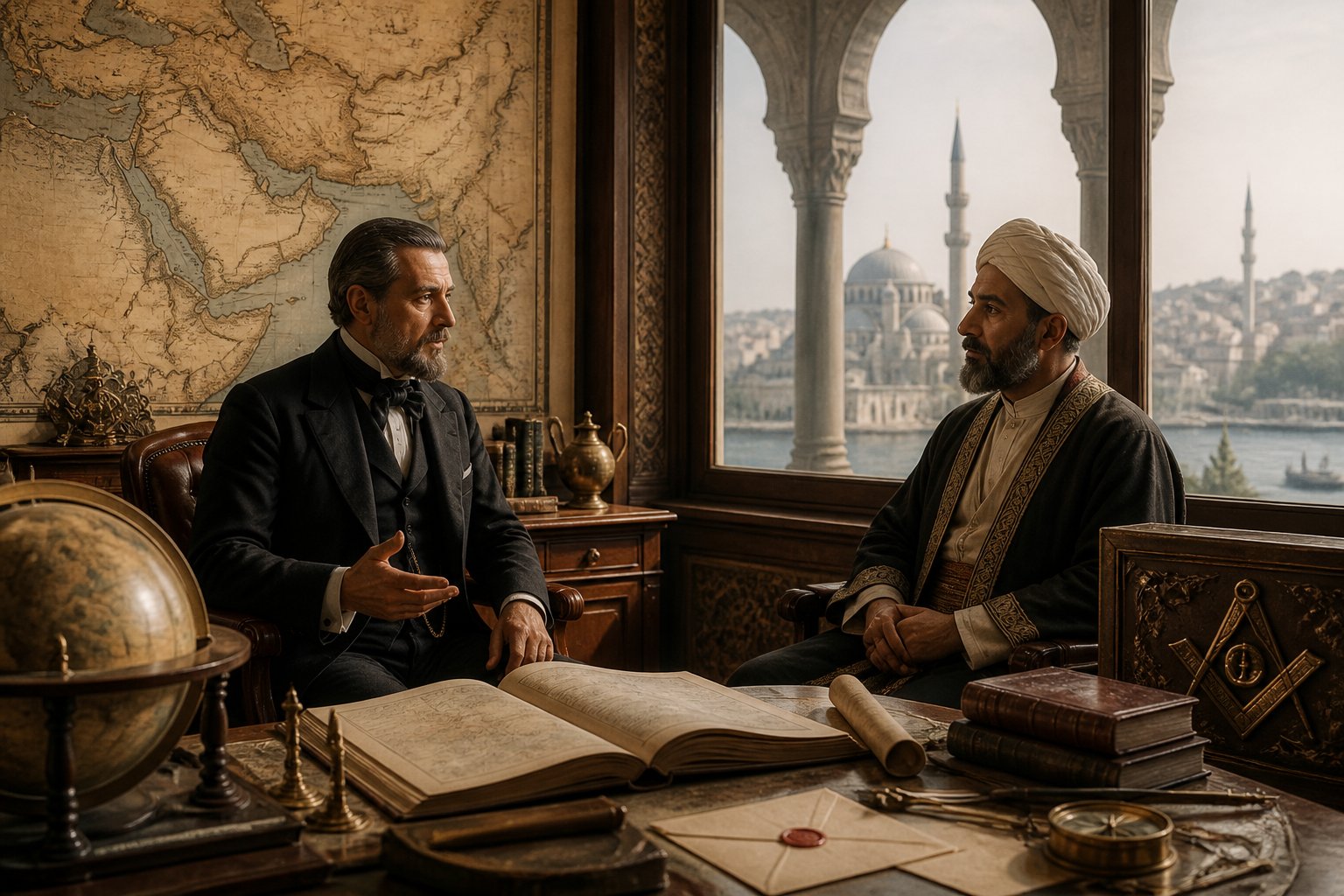
European imperial expansion connected Masonic organizations with diplomats, merchants, soldiers, and administrators across the Middle East. In port cities, lodges often brought together foreign residents and local elites, while their membership reflected the political and commercial networks of the Ottoman and colonial eras.
Diplomacy, Trade, and Colonial Networks
We should place Freemasonry within the movement of people and institutions across the British, French, and Ottoman worlds. European merchants, consular officials, military officers, and engineers established or joined lodges in cities such as Alexandria, Beirut, Cairo, Jerusalem, and Istanbul. These lodges did not operate as a single imperial administration, but they created social settings in which professional contacts could develop.
British influence helped expand lodge networks in parts of the region during the nineteenth century, especially as trade and colonial administration increased. Membership could provide access to trusted contacts across national boundaries, although it did not guarantee political agreement or official influence.
Freemasonry also attracted prominent Middle Eastern figures. The Algerian leader Emir Abd al-Qadir, for example, was initiated in Alexandria in 1864 after contact with French and Egyptian lodges. His case illustrates how Masonic institutions could connect anticolonial, Ottoman, European, and local political worlds without reducing those relationships to a single imperial purpose.
Local Lodges and Cosmopolitan Port Cities
We find the clearest evidence of this interaction in cosmopolitan ports, where multilingual communities lived and worked together. Alexandria, with its Egyptian, Ottoman, European, Jewish, Greek, and Levantine populations, supported lodges that reflected the city’s commercial diversity. Beirut and Istanbul likewise provided settings where merchants, officials, professionals, and intellectuals could meet beyond the formal structures of government or religious institutions.
Local lodges varied considerably. Some operated under foreign jurisdictions, while others developed within Ottoman or national frameworks. Their rituals used European Masonic forms, but their membership and activities depended on local conditions.
Western visitors sometimes compared Sufi orders with what they called “Oriental Freemasonry.” We should treat that comparison cautiously: it reflected European attempts to interpret unfamiliar institutions through familiar categories, not proof that Sufi organizations and Masonic lodges shared identical origins or practices.
Notable Figures and Their Regional Connections

We should distinguish documented Masonic membership from broader political or cultural associations. T. E. Lawrence’s wartime contacts, Winston Churchill’s imperial administration, and King Farouk’s reported royal patronage illustrate three different relationships between prominent figures, Freemasonry, and the Middle East.
T. E. Lawrence and Arab Revolt Networks
T. E. Lawrence, widely known as Lawrence of Arabia, served as a British Army intelligence officer during the Arab Revolt of 1916–1918. He worked with Sharif Hussein’s sons, especially Emir Faisal, and helped coordinate military and political operations against the Ottoman Empire. His regional connection rests on these documented wartime networks, not on proven Masonic activity.
We should treat claims that Lawrence was a Freemason cautiously. Reliable biographical evidence does not establish him as a documented member of a Masonic lodge. Accounts that connect him to Freemasonry often rely on speculation about his contacts, symbols, or the secretive nature of wartime organizations rather than verified lodge records.
Winston Churchill and Imperial Policy
Winston Churchill was a documented Freemason and joined Studholme Lodge No. 1591 in London in 1901. His membership formed part of his public life, although Freemasonry did not determine his political positions or represent official British policy.
Churchill’s Middle Eastern connection came through imperial administration and military decision-making. As secretary of state for the colonies from 1921 to 1922, he helped shape British policy in Iraq, Transjordan, and Palestine. He supported arrangements that placed Faisal on Iraq’s throne and Abdullah in Transjordan, while balancing local opposition, imperial interests, and the cost of military occupation. We should keep these political decisions separate from his Masonic affiliation.
King Farouk of Egypt and Royal Patronage
King Farouk ruled Egypt from 1936 until his abdication in 1952. Sources frequently identify him as a Freemason, but public evidence about his specific lodge membership and activities remains less consistent than the records available for Churchill. We should therefore describe his connection as reported rather than definitively documented.
Egypt had an established Masonic presence before Farouk’s reign, including lodges linked to European, Ottoman, and local communities. Royal association could provide social prestige and visibility, yet it did not make Freemasonry an instrument of Egyptian government. Farouk’s reign faced British influence, nationalist opposition, economic inequality, and military dissatisfaction. Those forces, rather than Masonic networks, best explain the political crisis that ended his rule.