
Freemasonry has included politicians, artists, scientists, and public figures, but claims about membership require careful verification. When we examine their connections to the UAE, we must separate documented travel records from speculation and widely repeated rumors.
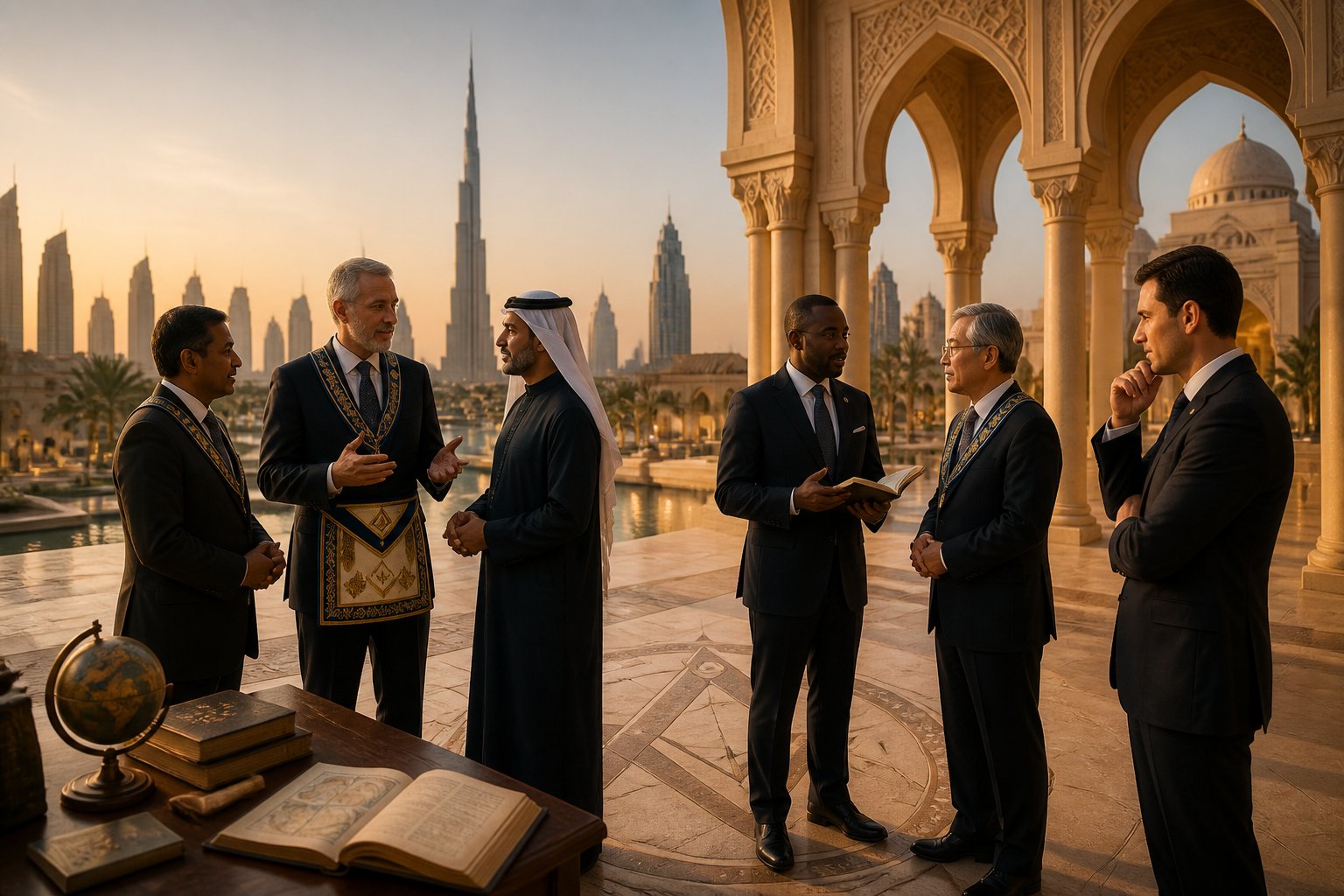
Publicly available evidence does not establish a definitive group of famous Freemasons who have traveled to the UAE; verified cases require reliable records linking both their Masonic membership and their visit. We will assess those records, explain the limits of public information, and examine notable visitors whose UAE connections appear in credible sources.
This approach helps us distinguish confirmed facts from assumptions while exploring how Freemasonry’s international history intersects with the UAE.
Freemasonry, Public Records, And UAE Travel
We should separate proven Masonic membership from rumor and distinguish a person’s documented UAE visit from claims based on association or inference. Reliable identification depends on independent records, while travel claims require dates, locations, and credible sources.
Standards For Verifying Masonic Membership
We should treat Masonic membership as verified only when supported by strong evidence, such as lodge records, official obituaries, contemporaneous biographies, or a direct statement from the individual. Reputable Masonic organizations may also provide useful confirmation, but secondary websites and unsourced celebrity lists require caution.
A person’s values, friendships, symbols, or alleged links to secret societies do not prove membership. We should also distinguish between initiated member, honorary recognition, and unverified allegation. Historical claims often remain disputed when records are incomplete, translated inconsistently, or repeated without a primary source.
When documenting a personality, we should record the lodge or jurisdiction, approximate membership dates, and the source supporting each fact. This approach prevents us from presenting uncertain claims as established history, especially because public information about Freemasonry in the UAE remains limited and may not confirm individual affiliations.
Documented Visits To Dubai And Abu Dhabi
We should verify UAE travel through dated evidence, including official itineraries, government announcements, event programs, reputable news reports, interviews, or the person’s own public statements. A photograph in Dubai or Abu Dhabi can establish presence, but it does not by itself confirm the purpose, date, or connection to Freemasonry.
We should identify the emirate and context precisely. A visit might involve a business meeting, cultural event, diplomatic engagement, performance, conference, or private travel; it should not be described as a lodge visit without specific documentation.
Search results that mention Freemasonry in the UAE generally describe historical presence, secrecy, international links, or charitable activity rather than naming verified visitors. We should therefore avoid linking famous Freemasons to UAE travel unless independent sources confirm both their membership and their presence in the country.
Notable Visitors And Their UAE Connections
Freemasonry records and travel accounts do not establish a reliable list of prominent Masons who visited the modern UAE. We should distinguish documented travel from later claims, especially when historical figures traveled through regions that now fall within the Emirates.
Winston Churchill And Historical Travel Claims
Winston Churchill was a documented Freemason, initiated into Studholme Lodge No. 1591 in 1901. He also traveled extensively across the Middle East during his military and political career, but available evidence does not clearly confirm a visit to the territory that became the United Arab Emirates.
Churchill visited places including Egypt, Palestine, and Iraq, and he attended the 1921 Cairo Conference while serving as colonial secretary. Those journeys often appear in discussions about British influence in the Gulf, yet they should not be presented as proof that he personally visited Abu Dhabi, Dubai, Sharjah, or another emirate.
We should also separate Churchill’s documented Masonic membership from unsupported claims about lodge activity in the UAE. British officials, merchants, and military personnel helped shape regional networks, but Churchill’s personal connection to the Emirates remains unverified.
Rudyard Kipling And Regional Travel Context
Rudyard Kipling’s relationship with Freemasonry is well documented. He joined Hope and Perseverance Lodge No. 782 in Lahore in 1886, and his experiences in British India influenced several literary works involving Masonic themes.
Kipling traveled widely in India and later visited parts of Asia, North America, and South Africa. However, reliable biographical sources do not establish that he visited the modern UAE. References to his regional connection usually reflect the broader British imperial and maritime setting rather than a confirmed journey to the Emirates.
We should avoid treating stories about Masonic symbolism in Kipling’s writing as travel evidence. His lodge membership and South Asian experience provide historical context, but they do not demonstrate a personal UAE connection.
Modern Public Figures And Source Limitations
Search results sometimes list celebrities, politicians, and business figures as Freemasons, while separate sources record visits by international personalities to the UAE. These two categories rarely overlap with reliable documentation. A public appearance in Dubai or Abu Dhabi does not prove Masonic membership, and an alleged membership does not prove travel to the country.
We should require two separate forms of evidence: a credible record of lodge membership and a reliable account of the person’s UAE visit. Official biographies, lodge archives, reputable newspapers, and government announcements provide stronger support than unsourced celebrity lists or social-media posts.
This standard matters because Freemasonry remains private in many jurisdictions. When records do not confirm both facts, we should describe the connection as unverified rather than identify the person as a confirmed Masonic visitor.