There is no verified evidence that any international celebrity holds Masonic membership through a lodge in the United Arab Emirates, and Freemasonry does not operate openly or legally as an organized fraternity in the UAE. Most claims linking famous names to Emirati lodges come from social media speculation rather than documented lodge records.
Freemasonry’s status across the Gulf region is restrictive. Bahrain’s Ministry of Labour and Social Affairs banned Masonic practice outright, and several neighbouring states treat the fraternity as an unregistered organization. That legal reality makes the persistent rumours about Dubai lodges and celebrity initiations worth examining carefully.
We look at where these stories originate, which international figures have genuinely confirmed Masonic membership elsewhere in the world, and how symbols in architecture and entertainment get misread as proof of secret affiliations.
Understanding Freemasonry in the UAE

Freemasonry occupies an unusual position in the Gulf: it is not formally chartered by any regular grand lodge in the Emirates, yet stories about famous visitors and their supposed lodge affiliations circulate widely. Sorting fact from speculation requires knowing both the legal position in the country and how Masonic membership is actually documented.
Legal and Cultural Context
Regular Freemasonry does not operate openly in the UAE. There are no lodges warranted by the United Grand Lodge of England, the Grand Lodge of Scotland, or the Grand Lodge of Ireland registered in Dubai or Abu Dhabi.
This reflects a wider regional pattern. Within the Arab world, organised Masonic activity is largely confined to Lebanon, which hosts several regular constitutions, and Jordan, where Jordan Lodge works under Scottish jurisdiction.
Elsewhere in the Gulf the position is more restrictive still. Bahrain’s Ministry of Labour and Social Affairs issued a prohibition on Masonic practice, pushing any remaining activity out of public view.
Religious objection underpins much of this. Several Islamic legal bodies have issued rulings declaring Masonic membership incompatible with Islam, and the fraternity is frequently linked in regional commentary to Zionism or foreign influence.
The historical footprint, however, is real. British colonial administration brought lodges to Iraq, Egypt, and parts of the Gulf during the nineteenth and early twentieth centuries, and some Emirati families retain relatives who joined abroad.
Distinguishing Membership From Rumor
Claims about celebrities and Freemasonry in the UAE fall apart under scrutiny more often than not. A useful filter:
| Type of claim | Reliability |
|---|---|
| Grand lodge records or published membership rolls | Verifiable |
| Public statement by the individual | Generally reliable |
| Photograph of hand gestures or jewellery | Not evidence |
| Social media attribution with no source | Unreliable |
Two problems recur.
First, jurisdiction confusion. A performer who is a genuine Mason in the United States or Britain does not become a UAE Mason by playing a concert in Dubai; membership travels with the individual, not the venue.
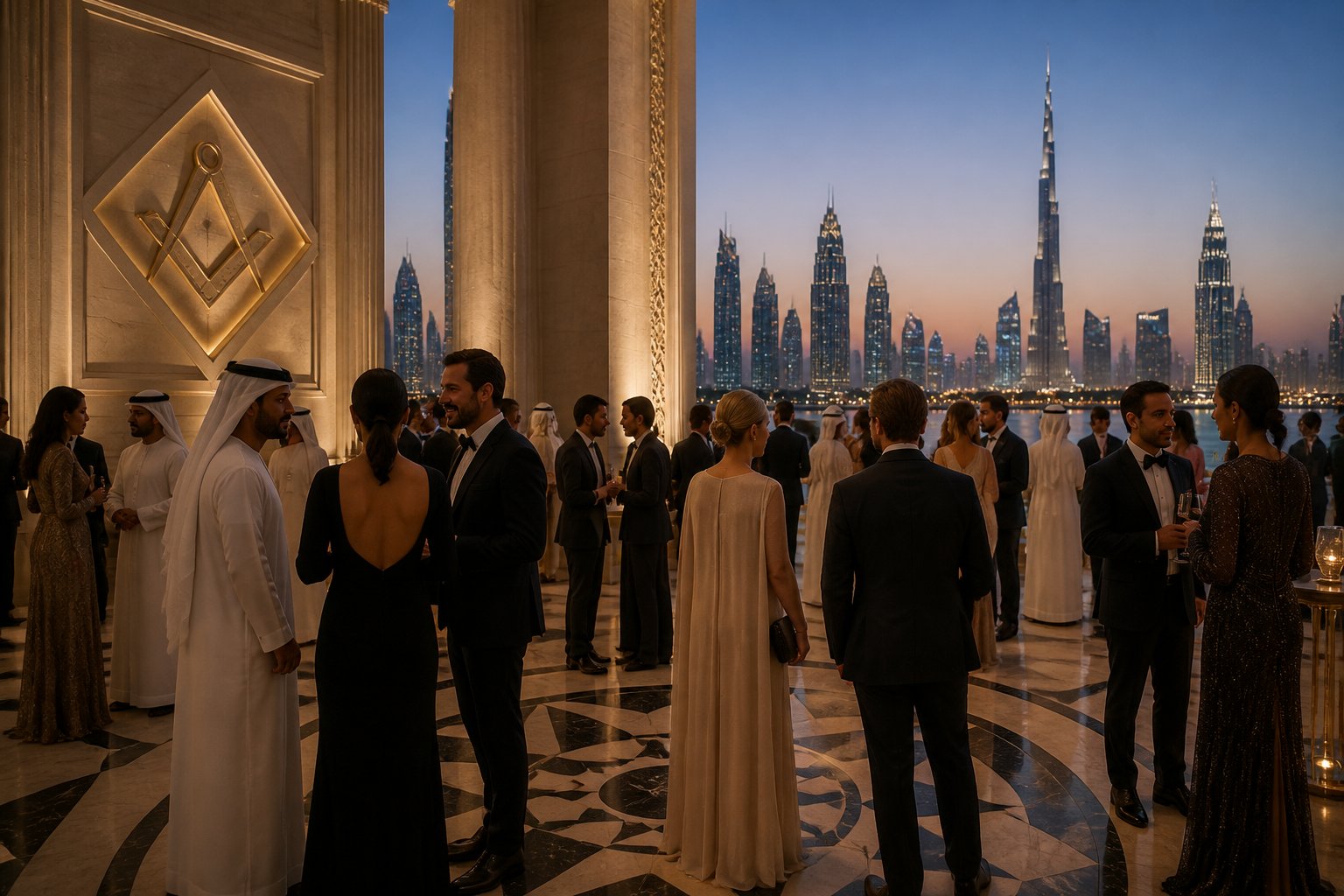
Second, symbol misreading. Compasses, squares, and checkerboard patterns appear in architecture and fashion worldwide without Masonic intent.
We would also note that irregular or self-declared “lodges” sometimes appear online claiming Emirates addresses. These carry no recognition from established grand lodges, and any celebrity name attached to them should be treated with caution.
Assessing Celebrity-Related Reports

Claims linking well-known figures to Freemasonry in the UAE circulate widely, yet most trace back to social media posts, anonymous forums, or content aggregators rather than verifiable records. We apply a consistent set of tests: the quality of the source, whether the individual or an official body has confirmed anything, and the legal and ethical limits on naming private individuals.
Standards for Reliable Evidence
We treat a claim as supported only when it can be traced to a source that can be independently checked.
Useful evidence includes lodge membership records, minutes or registers held by a recognised Grand Lodge, court filings, and reporting by established news organisations that name their documentation.
Weak evidence dominates this subject area. Common examples include:
- Photographs interpreted through hand gestures, clothing, or jewellery
- Music videos or album artwork read as coded signalling
- Screenshots of documents with no archival reference
- YouTube or TikTok narration citing other videos as proof
- Websites listing “famous Freemasons” without sourcing individual entries
A further complication is jurisdictional. Freemasonry is not licensed as an association in the UAE, so no local registry exists that could confirm or deny membership for anyone, celebrity or otherwise.
Public Statements and Documented Associations
Some public figures internationally have spoken openly about Masonic membership, and those statements are quotable. Historical figures with documented lodge records fall into the same category.
We distinguish three situations that are frequently blurred together:
| Category | What it means | How we report it |
|---|---|---|
| Self-disclosed membership | The person has stated it publicly | Attribute to the statement, with date and outlet |
| Verified historical record | Lodge registers or archives confirm it | Cite the holding institution |
| Alleged or inferred | Based on imagery, rumour, or association | Describe as an allegation, name the source |
Attendance at an event held in a Masonic building, friendship with a member, or a UAE business visit tells us nothing about affiliation. We say so directly rather than leaving the inference open.
Privacy, Defamation, and Responsible Attribution
UAE law treats reputational harm seriously. Federal legislation on cybercrime and defamation covers false statements published online, and penalties can apply to material that damages a person’s reputation regardless of whether the publisher is based in the country.
That framework shapes how we write. We avoid presenting unverified affiliation claims as fact, and we do not name individuals who have never addressed the subject publicly.
Where a rumour is itself newsworthy because of its reach, we describe the rumour and its origin, not the person as a member.
We also recognise that membership in a lawful fraternal organisation is, in most jurisdictions, private information. Publishing it without consent raises privacy concerns separate from accuracy — a point that applies equally to figures who are prominent in entertainment, sport, or business.